The Free Malaysia Today (FMT) reported on 10 November that ex-senior Anti-Corruption Agency (ACA) officer, Ramli Manan said there is ample evidence for the anti-graft agency to investigate the financial fiasco involving state investor 1MDB.
Ramli Manan said investigators had only to look into 1MDB-related court proceedings in Singapore and the United States’ Department of Justice (DoJ) reports to assist them in their probes.
Singapore’s investigation into the fund has resulted in the termination of BSI Bank’s license and the arrest of its bankers for assisting in laundering of 1MDB funds. Even as we speak, the Singaporean investigations still continue, with police now examining the role of Wall Street bank Goldman Sachs’ in setting up fraudulent bond offerings for the fund. The US Department of Justice investigations more explicitly state their investigations are aimed at recovering assets bought using funds laundered from Malaysia’s 1MDB.
“The evidence there is glaring and it could be of great assistance to MACC officers,” said Ramli, who retired as director of the Sabah ACA.
He further confirmed my criticism of the Malaysian Anti-Corruption Commission (MACC) last week that the MACC and the Royal Malaysian Police have different responsibilities and jurisdiction. Ramli told FMT that “it is only the MACC that has the expertise and experience to carry out investigation on graft and abuse of power. Police only can probe Penal Code offences.”
The Minister in the Prime Minister’s Department in-charge of Integrity, Datuk Paul Low had on 1 November responded to me in Parliament that “investigations weren’t carried out because of existing investigations being done by the Public Accounts Committee (PAC), Bank Negara and the Police.”
The statement by the former Sabah ACA Chief only goes to prove that there could not be a more shameless and irresponsible reply from the Minister and the Government.
The MACC is clearly and willfully choosing to ignore readily-available evidence in order to protect those implicated in the multi-billion dollar scandal, including the Prime Minister and his family members.
We’d like to remind the MACC again of their role as an independent commission. Its actions should never be dictated or influenced by the actions of other authorities or agencies. To prove that the MACC is indeed independent and not cowardly, it should immediately kick off its investigations into the massive shenanigans in the company and ensure the culprits who have caused billions of ringgit in losses pay for their heinous crimes.
Showing posts with label Sabah. Show all posts
Showing posts with label Sabah. Show all posts
Wednesday, November 15, 2017


Tuesday, October 19, 2010
Budget 2011: Sabah & Sarawak Marginalised
With a whole series of multi-billion ringgit mega projects headlining Datuk Seri Najib Abdul Razak's Budget 2011 which seeks to be an integral step in “transformation towards a developed and high-income nation”, it has become clear as day that Sabah and Sarawak which became part of Malaysia on 16 September 2010 continues to remain marginalised and will be hard-pressed to significantly benefit from the Federal Government plans.
Purely by reviewing the budget speech by the Prime Minister last Friday and tabulating all the projects which have been listed, West Malaysia is the by far the biggest beneficiary, with our comrades in Sabah and Sarawak the biggest losers.
The value of all the projects cited which are specifically located in West Malaysia amounted to a massive RM109.74 billion and this will include some of the headline projects such as the RM40 billion MRT system for the Klang Valley, the RM26 billion KL International Financial District (KLIFD), an estimated RM10 billion worth of new highways, a RM10 billion mixed property development in Sg Buloh by EPF as well as the RM5 billion controversial 100-storey Warisan Merdeka.
In contrast, projects which are specifically for Sabah and Sarawak amounted to a meagre RM9.55 billion only or only 8.0% of the total value of these projects cited in the latest budget.
Is this continued marginalisation justifiable in the country's pursuit to become a high-income nation when it is Sabah and Sarawak who have contributed among the most to the Federal Government coffers, but who are ironically also at the same time most in need of funding to raise the standards of living of its people.
Over the past 6 years, the Federal Government has been heavily dependent on the income contributed from the oil and gas sector, especially from Petronas which finances the government in the form of income taxes, dividends, export duties as well as royalty payments. These contributions have formed an average of 40% or more than RM60 billion annually of the Federal Government's total income over the past few years. Based on 2007 data, both Sabah and Sarawak contributed 44.5% in terms of crude oil as well as 64.1% of natural gas production in the country, demonstrating the immense contribution from these states to the Federal Government.
At the same time, based on the 9th Malaysia Plan Mid-Term Review, Sabah and Sarawak remains among the poorest in the country. According to the report in 2007, the incidence of poverty in Peninsular Malaysia is 2.3%, while that in Sarawak is nearly double at 4.3%, and in Sabah its nearly 7 times higher at 16%.
Even these figures are highly suspicious and reeks of under-reporting as the state of basic infrastructure development in Sabah and Sarawak is drastically below that of Peninsular Malaysia. Based on 2009 data from the Ministry of Rural and Regional Development, 41% of both East Malaysian states are without rural water coverage, while the figure is only 10% in Peninsular Malaysia. The gap is even bigger for rural electricity coverage, when 23% is not covered in Sabah, 33% not covered in Sarawak but only 0.5% not covered in Peninsular Malaysia.
It is hence nearly impossible that poverty levels in Sabah and Sarawak as only 16% and 4.3% when 41% are without rural water while 23% and 33% are without electricity respectively. It's hard to imagine that it was only in 1970 when Sabah was the 2nd richest state in Malaysia after Selangor (which included Kuala Lumpur then) and today, it is by far the poorest.
What's more, despite constituting more than 60% of the land mass in the country, Sabah and Sarawak combined has only 6,390 km of paved roads while the Peninsula has more than 3 times the length at 21,589 km.
The vast contributions by the 2 East Malaysian states led by BN state governments to the BN-led Federal Government when contrasted against the meagre returns to the people of Sabah and Sarawak. It is not hence completely not surprising that the people of Sabah and Sarawak believe that they have been royally screwed and we have a Commonwealth Games gold medalist who chose to don Sabah colours and not that of Malaysia.
Table: Projects Listed In The Prime Minister's Budget 2011 Speech

Purely by reviewing the budget speech by the Prime Minister last Friday and tabulating all the projects which have been listed, West Malaysia is the by far the biggest beneficiary, with our comrades in Sabah and Sarawak the biggest losers.
The value of all the projects cited which are specifically located in West Malaysia amounted to a massive RM109.74 billion and this will include some of the headline projects such as the RM40 billion MRT system for the Klang Valley, the RM26 billion KL International Financial District (KLIFD), an estimated RM10 billion worth of new highways, a RM10 billion mixed property development in Sg Buloh by EPF as well as the RM5 billion controversial 100-storey Warisan Merdeka.
In contrast, projects which are specifically for Sabah and Sarawak amounted to a meagre RM9.55 billion only or only 8.0% of the total value of these projects cited in the latest budget.
Is this continued marginalisation justifiable in the country's pursuit to become a high-income nation when it is Sabah and Sarawak who have contributed among the most to the Federal Government coffers, but who are ironically also at the same time most in need of funding to raise the standards of living of its people.
Over the past 6 years, the Federal Government has been heavily dependent on the income contributed from the oil and gas sector, especially from Petronas which finances the government in the form of income taxes, dividends, export duties as well as royalty payments. These contributions have formed an average of 40% or more than RM60 billion annually of the Federal Government's total income over the past few years. Based on 2007 data, both Sabah and Sarawak contributed 44.5% in terms of crude oil as well as 64.1% of natural gas production in the country, demonstrating the immense contribution from these states to the Federal Government.
At the same time, based on the 9th Malaysia Plan Mid-Term Review, Sabah and Sarawak remains among the poorest in the country. According to the report in 2007, the incidence of poverty in Peninsular Malaysia is 2.3%, while that in Sarawak is nearly double at 4.3%, and in Sabah its nearly 7 times higher at 16%.
Even these figures are highly suspicious and reeks of under-reporting as the state of basic infrastructure development in Sabah and Sarawak is drastically below that of Peninsular Malaysia. Based on 2009 data from the Ministry of Rural and Regional Development, 41% of both East Malaysian states are without rural water coverage, while the figure is only 10% in Peninsular Malaysia. The gap is even bigger for rural electricity coverage, when 23% is not covered in Sabah, 33% not covered in Sarawak but only 0.5% not covered in Peninsular Malaysia.
It is hence nearly impossible that poverty levels in Sabah and Sarawak as only 16% and 4.3% when 41% are without rural water while 23% and 33% are without electricity respectively. It's hard to imagine that it was only in 1970 when Sabah was the 2nd richest state in Malaysia after Selangor (which included Kuala Lumpur then) and today, it is by far the poorest.
What's more, despite constituting more than 60% of the land mass in the country, Sabah and Sarawak combined has only 6,390 km of paved roads while the Peninsula has more than 3 times the length at 21,589 km.
The vast contributions by the 2 East Malaysian states led by BN state governments to the BN-led Federal Government when contrasted against the meagre returns to the people of Sabah and Sarawak. It is not hence completely not surprising that the people of Sabah and Sarawak believe that they have been royally screwed and we have a Commonwealth Games gold medalist who chose to don Sabah colours and not that of Malaysia.
Table: Projects Listed In The Prime Minister's Budget 2011 Speech

Sunday, October 10, 2010
Where is Batu Sapi?
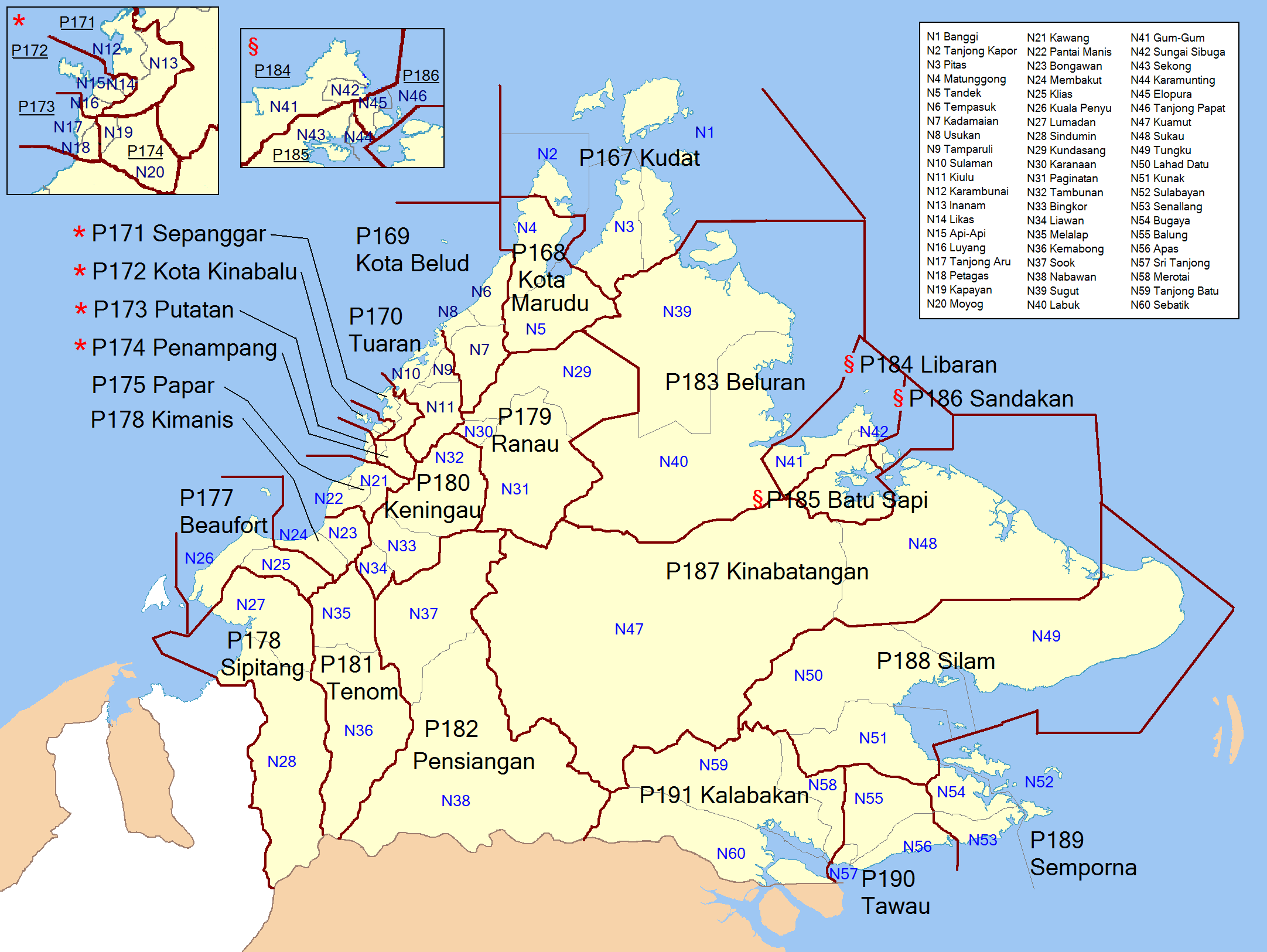
P185 Batu Sapi constituency is adjacent to Sandakan bordering Libaran and the (in)famous Kinabatangan. For the first time, I noticed how gigantic the Kinabatangan parliamentary constituency is, an estimate will be that it's nearly the size of Johor!
Oh, and one more little factoid, Sepilok is in Batu Sapi constituency, so we can visit the orang utans ;-)
And another little piece of trivia - "Sapi" means "cow" in Indonesian, and Batu Sapi means, literally, just that - "cow rock". And it looks like this:

Ah, at least we now know where the place got its name ;-)
Thursday, July 01, 2010

Subscribe to:
Posts (Atom)